Hawaii FHA Loan Specialist

Hawaii FHA Loans:
Island-Specific Limits Up to $1,149,825

Hawaii's FHA program operates under special rules that exist nowhere else on the mainland. With loan limits reaching $1,149,825 in Maui County, a leasehold property system dating to the 1848 Great Mahele, and condo eligibility requirements that affect nearly half of Honolulu's housing stock, navigating Hawaii FHA financing demands island-specific expertise.

$1,149,825
Maui County Limit
Highest in Hawaii
$828,000
Honolulu Limit
Oahu island
3.5%
Min Down Payment
580+ credit score
580
Min Credit Score
500 with 10% down

Understanding FHA Loans in the Hawaiian Islands

The FHA loan program operates differently in Hawaii than in any mainland state, starting with the loan limits themselves. Congress established a special ceiling for Alaska, Hawaii, Guam, and the U.S. Virgin Islands that allows FHA limits in these territories to exceed the standard FHFA high-cost area ceiling by 50%. This means while the highest possible FHA limit on the mainland is $1,149,825 (in counties like Los Angeles and San Francisco), Hawaii's non-contiguous territory designation allows Maui County to reach this same $1,149,825 ceiling based on its own median home prices rather than competing with mainland markets for the designation. The practical effect is transformative: an FHA buyer on Maui can finance a property approaching $1.2 million with just 3.5% down — a level of purchasing power that would require conventional or jumbo financing in most American markets.

But FHA limits tell only part of Hawaii's story. The real complexity lies in how the islands' unique housing characteristics interact with FHA's property eligibility rules. Hawaii's condominium-dominant housing market — particularly on Oahu, where approximately 45% of all housing units are condos — means FHA's project approval requirements affect a far larger share of potential purchases than in any mainland market. The leasehold property system, a legal framework with roots in Hawaii's monarchical land tenure system that has no meaningful parallel in any other state, introduces a separate set of financing rules. And Hawaii's geographic isolation creates inspection and appraisal logistics that simply don't exist when properties sit within driving distance of large appraisal markets. These interacting complexities make island-specific FHA expertise not a luxury but a necessity.

Hawaii's Island-by-Island FHA Landscape

Each Hawaiian island presents a distinct FHA financing environment shaped by its housing stock, economy, and demographic patterns. Oahu, home to nearly 70% of the state's population and the entire Honolulu metropolitan area, operates under an $828,000 FHA limit that covers a meaningful but declining share of Honolulu's housing market — the island's median home price has pushed above $900,000 in many neighborhoods. The military community represents a substantial FHA demand segment on Oahu, with Joint Base Pearl Harbor-Hickam, Schofield Barracks, Marine Corps Base Hawaii at Kaneohe Bay, and various smaller installations creating a steady flow of active-duty families who often choose FHA over VA financing when purchasing with a non-military co-borrower.

Maui County, encompassing Maui, Molokai, Lanai, and the tiny Kalawao settlement, carries the state's highest FHA limit at $1,149,825 — a figure driven by Maui's resort-influenced housing prices and the devastating impact of the August 2023 Lahaina wildfire on available inventory. The destruction of approximately 2,200 structures in Lahaina reduced Maui's already constrained housing supply, pushing prices higher even as rebuilding efforts continue. FHA's role in Maui's recovery is significant: the program's lower down payment and credit requirements make it accessible to displaced families who may have lost equity in the fire but retain income to support a mortgage payment.

Hawaii County (the Big Island) offers the state's most accessible FHA market with a $586,500 limit. The island's geographic diversity — from the tourism economy of the Kona coast to the agricultural communities of Hilo and Ka'u — produces a wider range of housing price points than any other Hawaiian island. Properties in the Puna district and parts of Hilo proper remain achievable at $350,000-$450,000, well within FHA territory with comfortable room for closing costs and repairs. However, Big Island FHA buyers must navigate unique property concerns including lava zone classifications (properties in Lava Zone 1, closest to Kilauea's active vents, may face appraisal challenges) and catchment water systems in rural areas where county water service doesn't extend.

Kauai County's $828,000 limit matches Oahu, reflecting the Garden Isle's premium pricing driven by limited developable land and persistent second-home demand. Kauai's North Shore and Poipu areas command prices that often exceed FHA limits, but the inland communities of Lihue, Kapaa, and Waimea provide FHA-eligible inventory at $500,000-$750,000. Lihue's growing workforce housing developments specifically target the local buyer demographic that FHA serves best.

The Condominium Challenge: FHA Approval in Hawaii's Condo-Dense Market

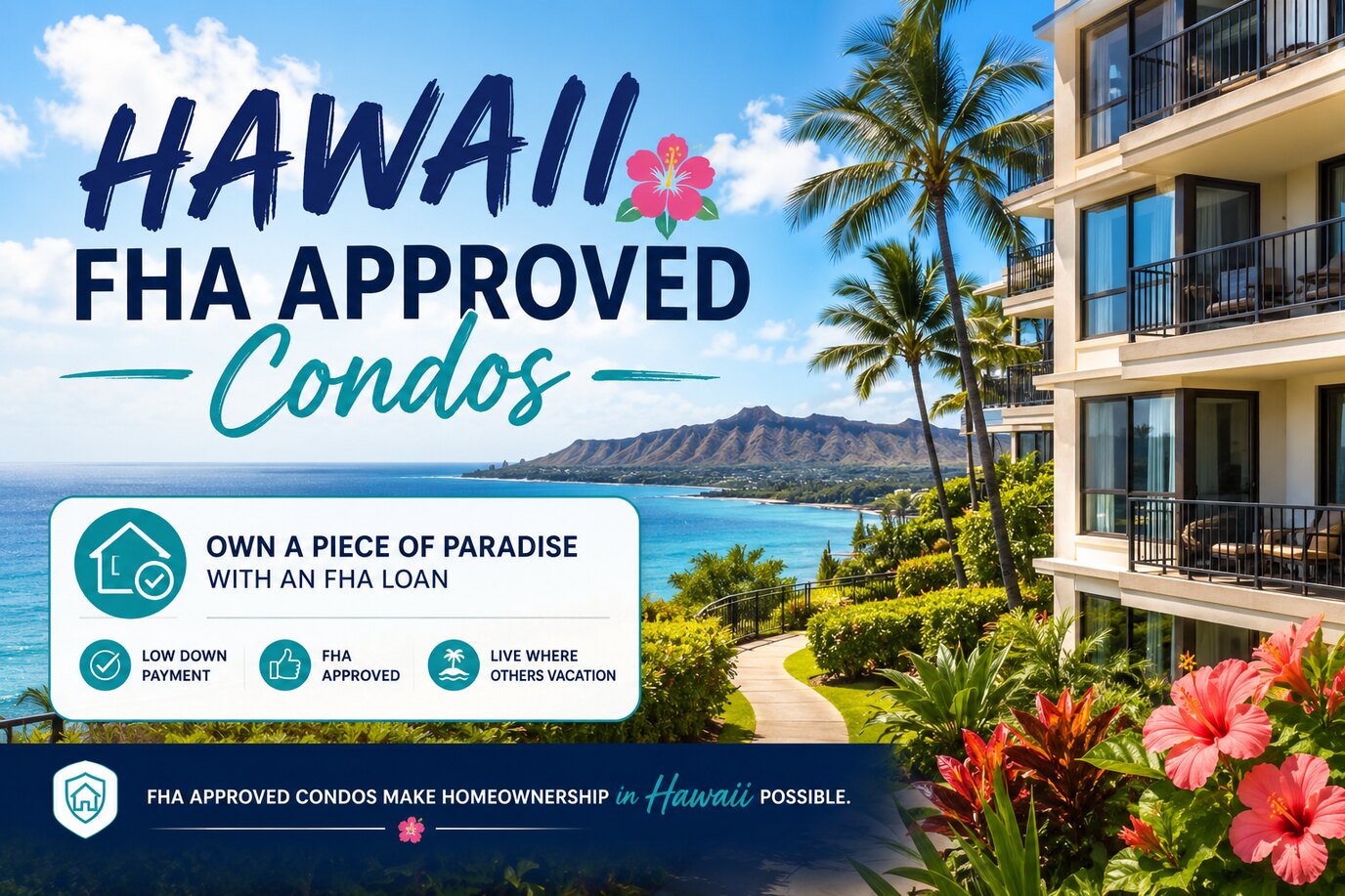
FHA's condominium approval requirements carry extraordinary weight in Hawaii because condominiums constitute such a dominant share of the islands' housing stock. In mainland markets, a buyer denied FHA condo financing simply shifts to single-family homes. In Honolulu, where land scarcity forced vertical development decades ago, condos are the primary housing type for middle-income buyers — not a secondary option. This makes FHA project approval status a make-or-break factor in a way mainland buyers rarely experience.

An FHA-approved condo project must meet specific financial health requirements: the homeowners association must maintain adequate reserve funds (typically 10% of the annual budget), the project must meet minimum owner-occupancy ratios (at least 50% owner-occupied for full project approval), commercial space cannot exceed 35% of total floor area, and the project must carry adequate hazard and liability insurance including flood coverage where applicable. In Hawaii, where many older Waikiki buildings were originally constructed as hotel or resort properties and later converted to residential use, these requirements eliminate a significant number of projects from FHA eligibility. Buildings with extensive short-term rental usage, deferred maintenance reserves, or ongoing special assessments for building envelope repairs (a growing issue in Hawaii's salt-air coastal environment) frequently fall short of FHA standards.

The FHA Single Unit Approval (SUA) process offers a pathway for purchasing in projects that lack full project approval, provided individual unit and project conditions meet specific criteria. However, SUA carries additional restrictions and requires more documentation, extending the approval timeline. I maintain a current database of FHA-approved projects across all Hawaiian islands and can identify eligible buildings early in the home search process, saving clients from investing time and inspection costs on properties that won't qualify for their financing.

Leasehold Properties: Hawaii's Unique Land Tenure System

Hawaii's leasehold property system has no meaningful equivalent in any other American state. Originating from the Great Mahele of 1848 — King Kamehameha III's division of Hawaiian lands between the crown, the government, and chiefs — large swaths of Hawaiian real estate remain held by institutional landowners including the Kamehameha Schools (Bishop Estate), the Queen Liliuokalani Trust, and various private trusts. Residential buyers purchase the improvements (the building) while leasing the underlying land for terms typically ranging from 30 to 65 years, though some older leases carry much shorter remaining terms.

FHA will finance leasehold purchases in Hawaii, but the remaining lease term must extend at least 10 years beyond the mortgage maturity date. For a standard 30-year FHA mortgage, this means the ground lease must have at least 40 years remaining at the time of loan origination. Additional FHA requirements include lease renewal provisions that protect the leaseholder, restrictions on arbitrary rent increases during the lease term, and limitations on the lessor's ability to cancel the lease outside of default conditions. The lease agreement itself must be reviewed and approved by the FHA lender, a process that can add 2-3 weeks to the transaction timeline. Leasehold properties typically sell at 20-40% discounts compared to equivalent fee simple properties, making them an attractive FHA option for buyers who prioritize current affordability over long-term land ownership — a reasonable calculation for military families on rotating assignments or buyers planning to own for less than 15 years.

Hawaii FHA Loan Limits by County

Hawaii benefits from special non-contiguous territory FHA ceiling provisions that push limits well above most mainland high-cost areas.

CountyIslands CoveredFHA Limit (1-Unit)Notes
Maui CountyMaui, Molokai, Lanai, Kalawao$1,149,825Highest FHA limit in Hawaii
Honolulu CountyOahu$828,000Covers 70% of state population
Kauai CountyKauai, Niihau$828,000Matches Honolulu ceiling
Hawaii CountyBig Island (Hilo, Kona)$586,500Most affordable island market

2025 FHA limits. Hawaii benefits from the 150% non-contiguous territory ceiling. Multi-unit limits available upon request.

Hawaii Down Payment Assistance Programs

Hawaii offers some of the nation's most generous DPA programs, reflecting the severe affordability challenges island residents face.

HHFDC Hale Kama'āina Program

Below-market rate mortgage (5.40-5.65%)

Administered by the Hawaii Housing Finance & Development Corporation, this program provides first-time homebuyers with mortgage rates approximately 0.75-1.25% below market. Income limits vary by county and household size. FHA-compatible. The program name — "Home of the Local Person" in Hawaiian — reflects its targeting of long-term Hawaii residents rather than investor or second-home purchasers.

Eligibility: First-time buyer, primary residence, income limits apply, must complete homebuyer education

City & County of Honolulu DPA

Up to $40,000

Honolulu's program provides direct down payment and closing cost assistance as a deferred, forgivable second mortgage. The funds are forgiven over a 10-year occupancy period, meaning buyers who remain in the home for a decade owe nothing back. This program can be layered with FHA financing, allowing an Oahu buyer to purchase with effectively zero out-of-pocket down payment.

Eligibility: Oahu properties only, income limits, 10-year occupancy requirement

HHOC Down Payment & Loan Assistance (DPAL)

Up to $125,000

The Hawaii HomeOwnership Center's DPAL program provides an extraordinary level of assistance — up to $125,000 as a deferred second mortgage at 0% interest with no monthly payments. The loan is repaid when the home is sold, refinanced, or the borrower no longer occupies the property. At current Hawaii home prices, this program can cover the entire 3.5% FHA down payment plus closing costs on properties up to approximately $3 million.

Eligibility: Statewide, income limits, primary residence, 30-year deferred repayment

Maui County Homeownership Program (HOP)

Up to $600,000

Established in response to the August 2023 Lahaina wildfire disaster, this program provides unprecedented assistance levels to help displaced families return to homeownership. The program covers down payment, closing costs, and gap financing to bridge the difference between insurance proceeds and replacement home costs. Priority is given to families who lost homes in the fire.

Eligibility: Maui County, wildfire-displaced families given priority, income limits apply

FHA for Military Families Stationed in Hawaii

Hawaii hosts one of the largest concentrations of military personnel in the United States, with Joint Base Pearl Harbor-Hickam alone supporting over 60,000 military and civilian personnel. Schofield Barracks, Marine Corps Base Hawaii (Kaneohe Bay), Fort Shafter, and Tripler Army Medical Center add tens of thousands more. While many military buyers gravitate toward VA loan financing, FHA serves a distinct niche in Hawaii's military community: dual-military couples where one spouse's credit profile is stronger, servicemembers purchasing with civilian co-borrowers who don't qualify for VA benefits, and military families who have already used their VA entitlement on a property in a prior duty station.

The Basic Allowance for Housing (BAH) rates for Hawaii installations reflect the islands' extreme housing costs. An E-6 with dependents stationed at Honolulu receives $3,912 per month in BAH — among the highest rates in the military system. Maui-based personnel (primarily associated with the Maui High Performance Computing Center and Pacific Missile Range support operations) receive $5,157 monthly. These substantial BAH amounts, which FHA lenders count as qualifying income, significantly expand purchasing power for military FHA borrowers. Combined with Hawaii's elevated FHA limits, a dual-military E-6 household can qualify for properties in the $700,000-$800,000 range with FHA financing — enough to access starter homes in communities like Ewa Beach, Kapolei, and central Oahu.

Navigating Hawaii's Cost-of-Living Impact on FHA Qualification

Hawaii's cost of living — approximately 80-90% above the national average — creates qualification dynamics that mainland FHA borrowers never encounter. While FHA lenders focus on the debt-to-income ratio rather than residual income (as VA loans do), the practical reality is that higher baseline living expenses reduce the income available for mortgage payments and increase the likelihood that borrowers carry consumer debt that inflates their DTI. Monthly food costs averaging $1,200-$1,500 for a family of four, electricity bills of $300-$500 (Hawaii's electricity rates are the nation's highest due to oil-dependent power generation), and the near-necessity of vehicle ownership on most islands all constrain the financial flexibility of potential FHA borrowers.

The mortgage insurance premium structure for FHA loans in Hawaii deserves particular attention given the elevated loan amounts. FHA charges an upfront mortgage insurance premium (UFMIP) of 1.75% of the loan amount — on an $800,000 Honolulu FHA loan, that's $14,000 rolled into the loan balance. The annual MIP of 0.55% adds approximately $367 per month to the same loan's payment. Unlike conventional PMI, which drops automatically at 78% loan-to-value, FHA's annual MIP now remains for the life of the loan on most purchase transactions (those with less than 10% down payment). For Hawaii buyers considering long-term ownership, I often discuss a strategic approach: use FHA for initial purchase accessibility, build equity through Hawaii's historically strong appreciation rates, then refinance into a conventional mortgage once you reach 20% equity to eliminate the ongoing MIP burden.

Hawaii-Specific FHA Property Requirements

FHA property standards in Hawaii incorporate inspections and evaluations that rarely arise in mainland transactions. Termite inspection is mandatory for virtually every Hawaii FHA purchase — the islands' tropical climate creates year-round conditions favorable to wood-destroying organisms, and FHA requires treatment of any active infestation before closing. Properties with existing termite damage must have structural repairs completed and re-inspected. The Formosan subterranean termite, an aggressive species prevalent in Hawaii, can compromise structural integrity within 2-3 years of infestation, making this inspection requirement genuinely protective rather than bureaucratic.

Hurricane preparedness requirements also affect FHA transactions in Hawaii. The state sits in a hurricane zone (Hurricane Iniki devastated Kauai in 1992, and Hurricane Lane threatened in 2018), and FHA requires adequate wind and hurricane insurance coverage. Since the Hawaii Hurricane Relief Fund was depleted after Iniki and the private hurricane insurance market contracted, many Hawaii homeowners now rely on the Hawaii Property Insurance Association (HPIA) for hurricane coverage. Annual hurricane insurance premiums of $1,500-$4,000 for typical residential properties add to the total housing cost that FHA borrowers must qualify to carry. Properties in flood zones require separate flood insurance, which FHA mandates and includes in the DTI calculation.

FHA Opportunities by Island

Oahu (Honolulu County)

Oahu's $828,000 FHA limit covers the lower-to-mid tier of the island's housing market. The strongest FHA opportunities exist in Ewa Beach, Kapolei, and the Second City developments of West Oahu, where newer single-family homes and townhomes fall within FHA price range. Central Oahu communities like Mililani and Wahiawa also offer FHA-eligible inventory. Downtown Honolulu and Waikiki condo markets present more FHA challenges due to project approval requirements.

Maui County

Maui County's $1,149,825 FHA ceiling — the highest in Hawaii — provides extraordinary purchasing power, though the post-wildfire housing shortage has pushed many listings above even this elevated limit. The Kahului-Wailuku corridor offers the island's most FHA-accessible inventory. Molokai and Lanai, also within Maui County, provide dramatically different (and more affordable) housing markets where FHA covers nearly all available properties.

Hawaii County (Big Island)

The Big Island's $586,500 FHA limit, while lower than other islands, provides access to a meaningful share of available inventory. The Kona coast resort side commands higher prices ($450K-$700K for single-family), while Hilo and surrounding Hamakua Coast communities offer more affordable options ($300K-$500K). Puna district properties, where lava flow risk varies by zone, present the island's most accessible price points but require careful lava zone evaluation.

Kauai County

Kauai's $828,000 FHA limit intersects with an island housing market shaped by tourism, agriculture, and strict development controls. The island's building height restrictions (no structure taller than a coconut tree) preserve character but limit supply. FHA-eligible inventory concentrates in Lihue, Kapaa, and Waimea. North Shore and Poipu properties generally exceed FHA limits, though occasionally a leasehold property in these areas falls within range.

Hawaii FHA Loan FAQ

What are the FHA loan limits in Hawaii?
Hawaii FHA limits vary by county and benefit from the special Alaska/Hawaii/Guam/Virgin Islands ceiling. Honolulu County (Oahu) has a limit of $828,000, Maui County (including Molokai, Lanai, and Kalawao) has the highest at $1,149,825, Hawaii County (Big Island) is $586,500, and Kauai County is $828,000. These are significantly higher than mainland limits due to Hawaii's elevated housing costs and the special statutory ceiling for non-contiguous territories.
Can I use an FHA loan to buy a condo in Hawaii?
Yes, but the condo project must be FHA-approved or qualify for the Single Unit Approval (SUA) process. Hawaii's condo-dense housing market makes this particularly important — approximately 45% of Honolulu's housing stock is condominiums. The project must meet FHA requirements including owner-occupancy ratios (at least 50%), adequate reserve funds, insurance coverage, and financial stability. Many popular Hawaii condo projects maintain active FHA approval, but older buildings and resort-oriented projects often do not qualify.
Can I buy a leasehold property with an FHA loan in Hawaii?
FHA will finance leasehold properties in Hawaii provided the remaining lease term extends at least 10 years beyond the mortgage maturity date. For a 30-year FHA loan, that means the lease must have at least 40 years remaining. The lease terms must also meet FHA requirements including renewal rights and restrictions on lease cancellation. Hawaii's leasehold system, which originated with the Great Mahele of 1848, still affects approximately 10-15% of residential transactions.
What down payment assistance is available for FHA loans in Hawaii?
Hawaii offers several DPA programs compatible with FHA financing. The HHFDC Hale Kama'āina program provides below-market-rate mortgage financing at 5.40-5.65% with reduced down payment requirements for first-time buyers. The City of Honolulu offers up to $40,000 in down payment assistance. HHOC's DPAL program provides up to $125,000 in deferred second mortgage assistance. Maui County established the Homeownership Program (HOP) with up to $600,000 in assistance for families affected by the wildfire disaster.
How does Hawaii's high cost of living affect FHA qualification?
Hawaii's cost of living — averaging 80-90% above the national average — significantly impacts debt-to-income ratios for FHA borrowers. Higher food costs ($1,200-1,500/month for a family of four), utility bills ($300-500/month due to oil-dependent electricity generation), and auto expenses all reduce the income available for mortgage payments. FHA allows up to 57% DTI in some automated approval scenarios, which provides more flexibility than conventional loans, but Hawaii buyers often need this full allowance to qualify given the elevated baseline living expenses.
Emmett Clark - Hawaii FHA Loan Specialist

Emmett Clark

NMLS #233747 | Hawaii FHA Loan Specialist

Hawaii's FHA landscape involves condominium approval rules, leasehold property financing, and island-specific loan limits that mainland lenders rarely encounter. Whether you're a military family PCS-ing to Oahu, a Maui local rebuilding after the wildfire, or a Big Island first-time buyer exploring Puna and Hilo, I'll guide you through every Hawaii-specific FHA requirement. Let's discuss your island homeownership path.

Serving Hawaii, Hawaii

Get Your FHA Loans Quote

Connect with Emmett directly. Quick response, personalized guidance for your Hawaii home purchase.

Prefer to Talk?

(866) 617-7381

Available 7 days a week

Why Contact Emmett?

  • ✓ Local Hawaii market expertise
  • ✓ Access to 240+ wholesale lenders
  • ✓ Same-day pre-qualification available
  • ✓ No obligation, free consultation

Explore Hawaii Loan Options